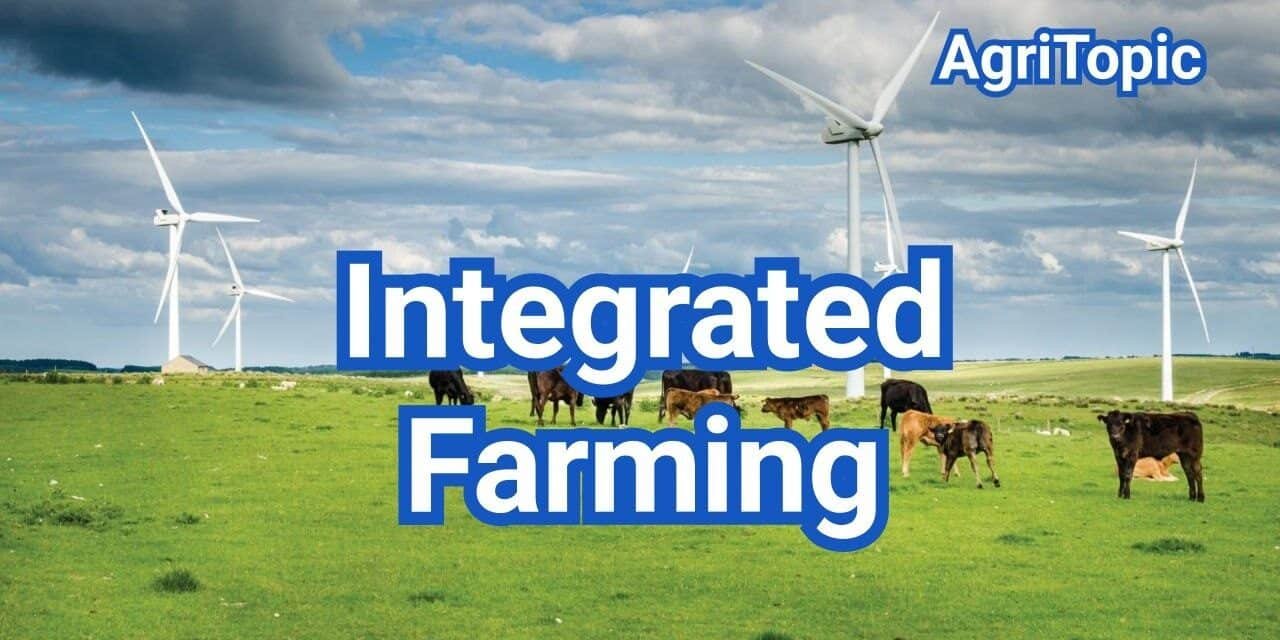
Integrated farming is the deliberate coordination of farm enterprises so land, feed, nutrients, water, or energy used or produced by one activity supports another. Its defining feature is a useful, managed connection between activities; producing several products on the same property does not, by itself, create an integrated system.
Quick Answer: For many U.S. farms, a practical starting point is to graze suitable cover crops with an existing herd or a neighboring producer’s livestock. Other options include using tested manure to meet crop nutrient needs or providing grazing services at a compatible solar site. Choose one connection, account for additional labor and infrastructure, and expand when the whole-farm result improves. Solar ownership and manure digesters are optional.
Can a cover crop provide useful livestock feed without delaying spring planting? Will manure reduce fertilizer purchases or create a nutrient surplus? Decisions like these determine whether integrated farming improves the performance of a U.S. farm.
This guide compares practical systems, explains how to coordinate crops and animals, and shows how to evaluate costs with a simple partial budget. It also covers food safety, optional energy projects, and the records needed to decide whether a new connection deserves more land, money, or management time.
Key Takeaways
- Evaluate each connection against the farm’s current practices, including any crop income or management time it displaces.
- Base stocking decisions on usable forage, animal needs, and soil conditions rather than acreage alone.
- Credit manure nutrients only when testing and crop requirements support an actual reduction in purchased fertilizer.
- Separate solar ownership, land leasing, and paid grazing services when calculating energy-related income.
- Track net returns, labor hours, animal performance, and the following crop before expanding a pilot.
How Integrated Farming Works: Follow the Resource Flows
A useful way to understand an integrated farming system is to follow a resource from one enterprise to another. A field produces grain and crop residue. Livestock use suitable residue or a following forage crop, and their manure returns nutrients to land where a future crop can use them. The connection becomes valuable when its timing, handling requirements, and costs fit the farm.
Each connection needs a purpose. Grazing might extend the feeding season, a forage phase might support a crop rotation, or a tree planting might supply shelter while producing a marketable product. The SARE overview of integrated crop-livestock systems identifies nutrient cycling, crop rotation, forage management, and stocking decisions as important parts of this approach.
Integration and diversification are related, but different
A farm growing vegetables and raising cattle is diversified because it sells different products. The enterprises become more closely integrated when they share a planned forage rotation, appropriately managed nutrients, equipment, or another useful resource. Different activities can remain financially separate while contributing to a coordinated production system.
Integration can also extend across property boundaries. A crop grower may provide winter grazing to a neighboring cattle producer, while the livestock owner supplies animals, temporary fence, and daily care. The biological connection can work without either business purchasing the other enterprise.
Identify the output, the user, and the limit
- Output: What resource becomes available, in what quantity, and during which season?
- User: Which enterprise can use it safely and productively?
- Handling: What equipment, transportation, storage, or labor makes the connection possible?
- Limit: What prevents overuse, contamination, soil damage, or interference with another crop?
- Value: Does the measurable benefit exceed the additional cost?
A resource described as “waste” is not automatically free. Moving manure, collecting residues, maintaining livestock water, or processing organic material can cost more than the recovered value. Successful integration accounts for those costs before the farm commits to a new enterprise.
Integrated Farming Examples for Different U.S. Farms
The following integrated farming examples illustrate different connections rather than a universal farm layout. Select a system that fits an existing resource, a realistic production window, and an available market. A farm can operate successfully with one strong connection and add other components later.
| Farm situation | Possible connection | Value to evaluate | Main constraint |
|---|---|---|---|
| Row-crop farm with a suitable cover-crop window | Cattle or sheep graze selected cover crops or harvest residues | Feed replacement or grazing income | Forage establishment, water, fencing, and the next planting date |
| Southern Plains wheat operation | Winter wheat supplies grazing before grain production | Livestock gain alongside a planned grain harvest | Timely livestock removal and protection of grain yield |
| Orchard or managed tree pasture | Compatible livestock use understory forage | Forage access, vegetation management, and tree products | Tree protection, forage light requirements, and harvest hygiene |
| Vegetable and poultry operation | Birds use designated rotation areas, with manure handled through an appropriate nutrient and food-safety plan | Egg or meat sales and useful nutrient recovery | Feed purchases, predators, nutrient loading, and separation from produce |
| Livestock business near a suitable solar installation | Sheep provide contracted vegetation management | Grazing fees and compatible forage access | Site access, animal care, equipment protection, and contract terms |
Midwestern crop-livestock systems
On a corn, soybean, or small-grain farm, an early harvest can create time to establish a useful forage cover. The opportunity depends on planting date, rainfall, temperature, and the following crop. A species that provides excellent spring growth may contribute little fall grazing if establishment occurs too late.
Begin with a clear forage objective and a locally suitable species or simple mixture. University of Minnesota Extension recommends starting with one or two cover crops and using early-harvested fields when possible in its guide to getting started with cover crops. A complicated seed blend does not compensate for a short growing window.
Dual-purpose wheat in the Southern Plains
Dual-purpose wheat provides a particularly clear example of competing enterprise priorities. Cattle gain value from additional grazing, while the grain enterprise needs sufficient leaf area and timely livestock removal. A grazing-only decision and a grazing-plus-grain decision require different budgets.
For wheat intended for grain harvest, Oklahoma State University identifies first hollow stem as the critical growth stage for removing cattle. Its first hollow stem guidance explains why relying only on a calendar date can sacrifice grain yield.
Orchards, tree pasture, and smaller diversified farms
Animals can use forage between trees, but access must match the crop and the animal’s behavior. Protect trunks, irrigation lines, and young plantings, and decide how animals will be kept away from harvest operations. The value of reduced mowing must be weighed against fencing, animal care, possible tree damage, and produce-safety requirements.
On a smaller vegetable farm, poultry may fit a designated non-produce rotation area or provide manure for a properly managed composting system. Purchased feed remains an important input, and frequent movement does not automatically prevent nutrient accumulation. Avoid treating direct movement of poultry manure into a fish pond or vegetable bed as a default design.
Dryland and water-limited systems
In drier regions, available water can determine whether an additional crop or grazing period is feasible. Added vegetation uses moisture, even when it provides useful cover or forage. Establish a plan for poor establishment, drought, and early removal of animals before assigning dependable feed value to an uncertain crop.
Regional guidance matters because an approach developed for a warm, humid growing season may perform differently in the western Great Plains. Southern SARE’s grazing-cover-crop guidance illustrates how planting windows, livestock management, and rainfall influence the available options.
Which System Fits Your Land, Labor, and Markets?
Before adding livestock, trees, fish, or energy equipment, identify a specific problem that the proposed connection will solve. An expensive winter feeding period, recurring vegetation-management bill, or poorly used crop residue provides a more useful starting point than a goal of adding as many enterprises as possible.
Screen the site before choosing the enterprise
Map usable fields, drainage patterns, water points, lanes, existing buildings, and areas that should remain protected. Then identify where animals, equipment, harvested products, and manure will move. A field with ample forage may still be a poor grazing candidate if access requires repeated travel through a produce harvest area.
- Land: Is the field trafficable, accessible, and suitable for the proposed crop or animal?
- Water: Can the supply meet peak demand, including hot weather and freezing conditions?
- Infrastructure: Are perimeter fences, handling facilities, loading access, and shelter adequate?
- Labor: Who performs daily tasks during planting, harvest, illness, or equipment failure?
- Markets: Is there a buyer, a grazing customer, or a measurable expense to replace?
- Exit: What happens if the forage fails or the proposed connection loses money?
Check the labor calendar, not just annual labor hours
An enterprise can fit the annual workload and still fail during a critical week. Lambing, vegetable harvest, cover-crop establishment, and equipment repairs may compete for the same people. Put these activities on a monthly calendar and identify tasks that cannot be postponed.
Shared machinery can reduce ownership costs, but availability matters. A drill needed for a cash crop may not be available when a short cover-crop planting window opens. Budget realistic custom-hire charges when an apparent equipment-sharing benefit depends on impossible timing.
Secure the market before planning expansion
Direct sales require time for processing arrangements, packaging, storage, delivery, and customer communication. A farm-to-table sales channel can support a diversified business, but an appealing production story does not establish a dependable price premium.
For service enterprises, clarify the unit being sold. A grazing contract may pay for animal days, vegetation outcomes, acreage, or a defined period. Each structure allocates drought, forage, and performance risk differently, so the projected income should match the actual agreement.
Crop and Grazing Methods That Protect the Next Harvest

Integrated farming methods work best when crop production and animal use are planned together. The question is not simply whether livestock can eat a plant. The farm must also establish enough forage, meet animal nutritional needs, retain protective cover, and leave the field ready for its next use.
Connect integrated cropping to the rest of the farm
Crop rotation, forage phases, cover crops, and suitable intercropping arrangements can all contribute to integrated cropping. Their role in a wider farm system should be explicit: supplying feed, maintaining living roots, supporting nutrient management, or changing the timing of field operations.
For example, a small-grain harvest may open a longer establishment window for a forage cover than a late corn harvest. That scheduling decision links crop production with livestock feeding. Evaluate any change in cash-crop revenue alongside the additional forage opportunity.
Write the crop and grazing sequence before turnout
- Identify the next crop and the conditions it needs for timely establishment.
- Choose the preceding crop, harvest date, and suitable forage-establishment method.
- Check the field’s pesticide history and all applicable grazing, haying, and feed restrictions.
- Estimate usable forage and match it to the class and number of animals.
- Set livestock removal, residual-cover, and wet-weather triggers.
- Plan cover-crop termination, field access, and any nutrient application.
Grazing does not necessarily terminate a cover crop. Plants may regrow, and a separate termination operation may still be required. Include that operation in the schedule and budget instead of assuming the animals have completed the work.
Estimate carrying capacity from usable forage
Stocking rate should reflect available dry matter, the portion animals can use while leaving the planned residual, and daily intake needs. Forage quality and animal class also matter: a diet that maintains mature dry cows may not support the intended growth of young stock.
A preliminary planning relationship is: potential grazing days = usable forage dry matter ÷ total daily herd dry-matter demand. Adjust the estimate for waste, uneven growth, weather, and the need to protect soil cover. Reassess the field as conditions change.
Locate water and minerals to support the grazing plan and reduce repeated congregation in the same places. Portable fencing can improve control, but frequent moves only help when the layout, water supply, and available labor allow the plan to be followed.
Protect the soil and retain a backup feeding option
Hoof action is not automatically beneficial. On wet soil, livestock can cause compaction, rutting, and damage to established plants. Remove animals when conditions threaten the field, and have an appropriate holding area or alternative feeding arrangement ready.
Retain enough vegetation and residue to meet the field’s conservation objectives. Maximizing short-term forage removal can undermine erosion protection or the next crop. Soil cover, trafficability, and animal performance should all influence the decision to move.
Distinguish forage hazards
Sorghum-family forages can present prussic-acid risks after frost or under other stressful conditions. Nitrate accumulation is a separate concern that can affect several annual grasses. Nebraska Extension’s annual-forage guidance explains why species, regrowth, harvest method, and testing matter.
Do not assume a fixed waiting period makes every stressed forage safe. Identify every species in the mixture, test suspect material, and obtain feeding guidance appropriate to the animals and the laboratory results. Maintain access to an alternative feed source when a grazing area must be closed.
Nutrient Recycling, Water, and Produce Safety
Manure connects livestock and crops, but useful recycling requires more than returning material to a field. The quantity, nutrient content, application method, crop demand, and contamination risk all affect the result. A system can recycle nutrients while still accumulating an excess.
Build a nutrient budget that includes imports
Purchased feed brings nutrients onto the farm. If animal numbers rise while the land available for nutrient use stays the same, manure may exceed crop requirements. Account for those imports alongside fertilizer, bedding, harvested products, and manure exported to other land.
Use soil and manure tests to estimate appropriate nutrient credits and application rates. Plant-available nitrogen varies with the material and its management, while phosphorus can accumulate when applications repeatedly exceed crop needs. The NRCS Nutrient Management standard provides a framework, with state-specific guidance needed for field implementation.
Credit a fertilizer saving only when the nutrient supplied is needed and actually replaces a purchase. Manure transport, storage, spreading, and testing also belong in the calculation. An organic fertilizer can have agronomic value without being the least-cost option for every field.
Keep raw manure, compost, and digestate distinct
Raw manure, finished compost, vermicompost, and digester effluent should not be treated as interchangeable materials. Their nutrient availability, handling requirements, and treatment history differ. A material’s appearance or product name does not establish that it meets the requirements for a particular crop or production standard.
For certified organic food crops, USDA’s raw-manure requirements generally call for incorporation at least 120 days before harvest when the edible portion contacts soil or soil particles, and 90 days for other food crops. The USDA guide to manure and compost explains these restrictions and distinctions among amendment types.
Apply produce-safety requirements to the actual operation
The FDA Produce Safety Rule has separate requirements for covered produce operations. Its provisions address amendment treatment and application, agricultural water, animal contamination, worker practices, and other risks. The 90/120-day organic intervals should not be presented as a universal FDA mandate.
FDA’s Produce Safety Rule overview explains that the rule does not establish a universal waiting period between grazing and harvest. Covered farms must assess relevant contamination risks and avoid harvesting produce likely to be contaminated. Organic certification and buyer requirements may add further conditions.
Separate water recovery from contamination pathways
Tailwater recovery can reuse irrigation return flows where the design and water quality suit the intended use. It does not make livestock-yard runoff automatically suitable for irrigating food crops. Identify potential contamination sources before connecting water systems.
Map clean-water supplies, livestock access, manure storage, drainage, and produce areas together. Maintain separation where needed, and check the requirements applicable to the crop, water source, and method of application. A useful resource connection should not create a new food-safety or water-quality problem.
Is Integrated Farming Profitable? Build a Partial Budget

Integrated farming can improve profit when it creates useful output or replaces a real expense at an acceptable additional cost. It can also lose money when infrastructure, labor, reduced crop income, or operating complexity outweigh those gains. More products and higher gross sales do not establish a better whole-farm result.
The USDA Economic Research Service report on cover crops and livestock operations examines how grazing or harvesting cover crops for forage can affect their economics. The relevant question is how the proposed connection changes the operation’s existing costs and returns.
Separate research findings from a farm-specific forecast
A Midwest Extension analysis of 2024 financial records reported average net returns of $128 per acre for 11 integrated farms, compared with $8 for a comparison group of 601 crop-only farms. The published crop-livestock economics brief describes substantial differences in land use between the groups.
The $120-per-acre difference is an observed comparison, not a guaranteed gain from adding livestock. The integrated sample was small, and the farms differed in enterprise mix and acreage use. Treat the result as evidence worth investigating, then calculate the proposed change using the farm’s own resources and costs.
Existing infrastructure can strongly affect payback. A SARE cover-crop grazing analysis used an assumed annual grazing value of $49.23 per acre and specifically noted that its early-return scenario depended on fencing already being available and water being accessible. That published assumption is not a current local price quote.
Use the four parts of a partial budget
A partial budget compares the proposed system with the current one. Include additional income and reduced costs on the benefit side. Include additional costs and any income sacrificed on the cost side.
Change in annual profit = additional income + costs avoided − additional costs − income lost. This measures the effect of the proposed change, rather than the profit of the entire farm.
For an existing herd, the value of new grazing might be purchased hay that is no longer needed. For a crop farmer contracting with another producer, it might be grazing rent. Do not count both as income to the same business unless the arrangement actually provides both.
Illustrative budget: a 20-acre grazing addition
The figures below are hypothetical teaching assumptions, not market quotes or a documented farm result. The example assumes an existing herd, no additional livestock purchase, unchanged animal output, and no change in the following cash-crop yield. Reusable fencing is charged an annual ownership and use cost.
| Budget item | Illustrative annual amount |
|---|---|
| Purchased feed avoided | $2,000 |
| Additional fertilizer purchases avoided after nutrient credits | $150 |
| Existing machinery operations avoided | $100 |
| Total benefits | $2,250 |
| Cover-crop seed and establishment | $900 |
| Additional labor: 18 hours at $25 per hour | $450 |
| Annual fence ownership and use cost | $300 |
| Additional water delivery and equipment moves | $225 |
| Additional testing, minerals, and minor repairs | $175 |
| Total additional costs | $2,050 |
| Illustrative change in annual profit | +$200, or +$10 per acre |
The small positive margin depends on achieving the assumed feed saving. If that saving falls by 25%, from $2,000 to $1,500, the result becomes a $300 loss. Any cash-crop yield reduction, extra livestock expense, or unbudgeted labor would further change the outcome.
In this example, break-even feed savings are $1,800: the $2,050 additional cost minus $250 in other savings. That gives the farmer a practical question to test during the pilot: can this forage reliably replace at least $1,800 of purchased feed under the stated assumptions?
Avoid double counting and separate profit from cash flow
Record transfers between enterprises consistently. Homegrown forage is an input to the livestock enterprise and an output of the crop enterprise, but its internal transfer value cancels when calculating whole-farm income. Counting that transfer as an outside sale would inflate the total.
Also distinguish annual ownership costs from cash required upfront. Fence depreciation or an annual capital charge helps evaluate profitability, while purchasing equipment and repaying loan principal affect cash flow. A project can show an acceptable annual margin and still create an unaffordable seasonal cash shortage.
For major solar or digester investments, develop a multiyear analysis that includes financing, maintenance, replacement, downtime, and conservative revenue assumptions. The EPA AgSTAR planning framework separates capital expenses, operating costs, revenues, ownership arrangements, and financing considerations.
When Solar Grazing or a Digester Makes Sense

Renewable energy belongs in an integrated farming plan when the agricultural and energy activities support a workable business arrangement. Begin by identifying the actual relationship: electricity for the farm, land leased to a developer, paid vegetation management, or energy recovered from a dependable manure stream.
Separate three different solar business models
- Farm-owned solar: The farm invests in equipment and evaluates electricity production against its usage, utility terms, and ownership costs.
- Land leasing: A developer uses the land under a lease; continued agricultural access depends on the agreement and site design.
- Contract grazing: A livestock operator provides a vegetation-management service, potentially without owning the land or solar equipment.
Do not combine electricity sales, lease payments, and grazing fees in one forecast unless the farm is entitled to each revenue stream. A shepherd managing a solar site may receive a service payment while the developer retains all electricity income.
Sheep can fit many solar installations, while cattle may require greater panel clearance and additional design work. Cable protection, water, access, fencing, and vegetation requirements should be addressed before animals arrive. The Department of Energy’s farmer solar guide explains these design considerations and the potential roles of grazing.
Solar grazing may reduce mechanical vegetation management, but it does not necessarily eliminate mowing or weed control. Some plants may be unpalatable, and vegetation near sensitive equipment may need separate treatment. Specify these responsibilities in the service agreement.
Screen the manure stream before considering a digester
An anaerobic digester uses microorganisms to break down suitable organic material without oxygen, producing biogas and digestate. The EPA explanation of digestion benefits describes potential energy, manure-management, and nutrient-recovery uses. The remaining digestate still requires appropriate storage and nutrient management.
Recoverable manure matters more than animal numbers alone. Material deposited across extensive pasture is different from manure collected regularly at a central location. Feedstock consistency, contamination, water content, and the available gas market influence whether a project can operate reliably.
Small farms are not automatically excluded, but their projects require favorable operating and financial conditions. EPA’s livestock-biogas FAQ discusses small-farm suitability, manure collection, and the importance of a viable business model.
Before committing, identify the operator, maintenance support, permits, gas use or buyer, backup handling capacity, and responsibility for outages. Include the cost of managing additional nutrients if outside feedstocks are accepted. Gas production does not remove the need to account for nitrogen and phosphorus.
Agroforestry and Pest Control: Add Services with Clear Limits
Trees, habitat plantings, and livestock can provide services alongside agricultural products, including shelter, vegetation management, and support for beneficial organisms. Each addition should have a defined role and a maintenance plan. Its benefits need to be evaluated alongside possible competition for land, light, water, and labor.
Manage the tree, forage, and animal layers together
Silvopasture requires active management of trees, forage, and livestock. Simply opening woodland to animals does not establish a productive silvopasture system. University of Minnesota’s silvopasture guidance emphasizes light, appropriate species, fencing, water access, and protection of young trees.
Allow space for equipment, animal movement, and changing tree canopies. A forage species that performs well during establishment may decline as shade increases. Likewise, a tree selected for future income must have a suitable market and be protected from browsing or physical damage.
Use pest monitoring to evaluate biological services
Poultry, grazing animals, rotations, and habitat strips may contribute to pest management, but their presence does not establish effective control. Monitor the target pest, crop damage, and the effects on beneficial species. Livestock themselves can introduce plant damage, parasites, or food-safety conflicts that require separate management.
The EPA principles of integrated pest management combine identification, monitoring, action thresholds, prevention, and appropriate controls. IPM can include carefully selected pesticides; it is not equivalent to organic certification or a guarantee that chemical intervention will never be needed.
These ecological connections also relate to agroecology, but practical results depend on the particular field and management system. Measure the service provided instead of assigning a fixed pest-control or soil-health benefit to every added species.
A First-Season Plan and Farm Performance Checklist
A useful pilot tests one defined connection at a scale the farm can manage. Set a written objective, such as replacing part of a winter feed purchase or earning grazing income from an existing cover crop. Decide what evidence would justify expansion and what result would require redesign.
| Stage | Main work | Decision to document |
|---|---|---|
| Before establishment | Record the baseline, select the field, check restrictions, prepare infrastructure, and build the budget | Is the proposed connection feasible with available resources? |
| Before livestock entry or operation | Assess forage or feedstock, water, access, safety, and staffing | Are conditions suitable to begin? |
| During the pilot | Track output, expenses, labor, field conditions, and interruptions | When should operations change or stop? |
| After the following harvest | Reconcile actual costs and savings, including effects on the next crop | Should the farm continue, modify, expand, or discontinue the connection? |
Keep a short, useful performance dashboard
- Financial: Change in net return, cash required, and revenue actually received.
- Labor: Hours by task, emergency work, and conflicts with other enterprises.
- Livestock: Grazing days, purchased feed, weight gain or other output, health events, and losses.
- Crops and soil: Following-crop yield, planting delays, residual cover, rutting, and consistent soil-test trends.
- Nutrients: Manure movements, nutrient credits, purchased fertilizer, and fields approaching application limits.
- Energy: Usable production, payments or savings, maintenance, downtime, and agricultural output retained.
Where practical, compare the pilot with a similar area managed under the existing system. Record weather and field differences so they are not mistaken for treatment effects. Several seasons may be needed to understand reliability, particularly where forage establishment or crop response varies widely.
Common mistakes that weaken an otherwise useful system
- Buying animals before arranging year-round feed, water, handling, and daily care.
- Counting all manure nutrients as fertilizer savings without testing or crop demand.
- Assuming livestock will terminate every cover crop or control every weed.
- Adding poultry, trees, and energy equipment before the first connection is manageable.
- Excluding family labor, repairs, financing, or lost crop income from the budget.
- Expanding a successful pilot into fields with different drainage, water access, or travel requirements.
Expansion should follow the limiting resource. If labor is already fully committed, additional acreage may reduce performance even when the pilot was profitable. Increase capacity deliberately and retain a workable response to drought, equipment failure, animal escape, or the loss of a buyer.
U.S. Assistance, Contracts, and Risk Management
Extension educators, conservation planners, veterinarians, lenders, and qualified technical specialists can help evaluate different parts of the system. Bring them a field map, a proposed calendar, available resource estimates, and a preliminary budget. Specific information produces more useful guidance than a general request to “build an integrated farm.”
Match conservation assistance to a resource concern
The Environmental Quality Incentives Program provides technical and financial assistance for eligible conservation work. Discuss the resource concern, applicable practices, payment schedule, and approval requirements with NRCS before assuming a planned expense will be funded.
The Conservation Stewardship Program supports maintaining and improving conservation through an agreed plan. It can be relevant to existing operations seeking additional stewardship improvements, but eligibility and contract requirements must be evaluated for the particular farm.
Check current energy-program restrictions
As of October 5, 2026, the USDA REAP program page states that grant applications are not being accepted and that guaranteed-loan applications may be submitted. Program eligibility and project-specific restrictions still apply, so an anticipated award should not be treated as secured financing.
A separate USDA notice on biodigester and controlled-environment agriculture projects extends a pause affecting loan guarantees through December 31, 2026, or until further guidance is issued. Confirm the current status with Rural Development before including such support in a digester financing plan.
Coordinate insurance and written agreements
Review grazing, haying, cover-crop termination, and the following insured crop with the farm’s approved insurance provider. The RMA cover-crop fact sheet provides background on good farming practices, but the current policy and applicable provisions should guide decisions.
When enterprises involve different owners, document responsibility for daily animal care, fencing, water, escapes, crop damage, biosecurity, access, payment, and early termination. Similar clarity is needed for solar-grazing services, manure transfers, and shared equipment. A biological connection works more reliably when the business responsibilities are equally clear.
Integrated Farming FAQs
What are the types of integrated farming?
Common types include crop-livestock systems, crop-tree systems such as alley cropping, tree-forage-livestock systems such as silvopasture, and appropriately designed fish-crop systems such as aquaponics. Energy may be added through compatible solar use or anaerobic digestion. There is no single required number of types; systems are usually described by the enterprises and resource flows being connected.
Does an integrated farm need to own livestock?
No. A crop farmer can work with a livestock owner through a grazing lease, custom-grazing agreement, or another clearly defined partnership. Animal ownership and land ownership can remain separate. The arrangement still needs dependable management, suitable infrastructure, and a clear allocation of costs and responsibilities.
Can integrated farming work on one acre?
Selected connections can work on one acre, but the design must account for buildings, access, buffers, manure handling, and usable growing space. A small vegetable enterprise with carefully managed poultry may be possible where local rules and markets allow it. Acreage alone cannot establish a safe animal number, complete feed self-sufficiency, or an expected income.
Is an integrated farming system the same as the USDA Integrated Farm System Model?
No. An integrated farming system is an approach to organizing agricultural activities. The USDA Agricultural Research Service’s Integrated Farm System Model, or IFSM, is computer simulation software used to study farm production, economics, and environmental effects. It is a research and planning tool, not a required layout or certification for operating an integrated farm.
Final Thought: Expand the Connections That Work
The strongest integrated farming system gives each connection a clear purpose. It may turn a suitable cover crop into feed, move tested nutrients to a field that needs them, or combine agricultural production with a paid management service. The benefit should remain visible after accounting for labor, infrastructure, risk, and effects on the next enterprise.
Start with the resources already available, test one manageable connection, and keep records that reveal both gains and losses. Expand when the biological results, work schedule, and financial performance support the decision.
Sources & References
- SARE: Integrated Crop and Livestock Systems
- USDA ERS: Cover Crops on Livestock Operations—Potential for Expansion in the United States
- University of Minnesota Extension: Getting Started with Cover Crops
- Southern SARE: Grazing Cover Crops in Cropland
- Oklahoma State University Extension: First Hollow Stem and Dual-Purpose Wheat
- Nebraska Extension: Managing Annual Forages After Frost
- USDA NRCS: Nutrient Management Conservation Practice Standard 590
- USDA Agricultural Marketing Service: Soil Building—Manures and Composts
- FDA: FSMA Final Rule on Produce Safety
- University of Wisconsin–Madison Extension: Economics of Crop and Livestock Integration
- SARE: Cover Crop Economics—When Cover Crops Are Grazed
- EPA AgSTAR: Project Planning and Financing
- U.S. Department of Energy: Farmer’s Guide to Going Solar
- EPA AgSTAR: The Benefits of Anaerobic Digestion
- EPA AgSTAR: Frequent Questions About Livestock Biogas Projects
- University of Minnesota Extension: Silvopasture
- EPA: Integrated Pest Management Principles
- USDA NRCS: Environmental Quality Incentives Program
- USDA NRCS: Conservation Stewardship Program
- USDA Rural Development: Rural Energy for America Program
- USDA Rural Development: Continued Pause on Biodigester and Controlled-Environment Agriculture Loan Guarantees
- USDA RMA: Cover Crops and Federal Crop Insurance
- USDA ARS: Integrated Farm System Model